
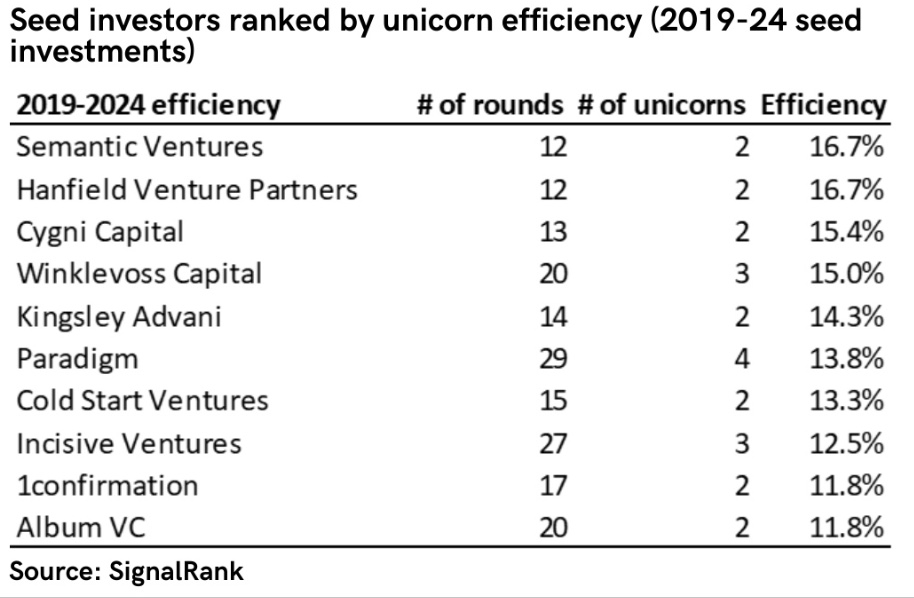
On Feb. 15, 2024, I held a webinar with over 100 investors and founders to discuss my approach to identifying unicorn companies in the Pre-seed. The next day, Signalrank, a Series B venture investor with a large database of investors, published their top 10 most capital-efficient VCs for picking Unicorns. Incisive Ventures is proud to be in the top 10 (they only had the three we did under our Incisive Ventures vehicles, not the other three that were personal investments).

Here is an AI-generated summary of the Webinar and the following Q&A. Link to the full video.
Quick recap
Martin Tobias discussed his approach to identifying potential “unicorn” companies, emphasizing the importance of reducing friction at scale and tailoring his specific investment thesis for B2B software companies. He also shared his extensive experience as a venture-funded CEO, having raised over $500 million for his own companies and invested in approximately 250 others. Martin highlighted the significance of understanding where his unique insights and network can provide an advantage in picking successful companies. He also discussed his investment strategies and philosophy, emphasizing the potential of counterintuitive ideas to prove successful when companies innovate and create new markets. Martin also shared his insights on the key skills venture capitalists need to succeed, emphasizing the importance of sourcing companies, convincing founders to choose their funding, supporting companies in their portfolio, and delivering good returns.
Summary
Identifying Unicorn Companies: Martin Tobias’s Approach
Martin Tobias, founder and managing partner of Incisive Ventures, shared his approach to identifying potential “unicorn” companies (with a valuation over $1B at some point in their life). He emphasized the importance of reducing friction at scale and explained his specific investment thesis which is tailored for B2B software companies. Martin also highlighted his extensive experience as a venture-funded CEO, having raised over $500 million for his own companies and invested in approximately 250 others. He stressed the significance of understanding where his unique insights and network can provide an advantage in picking successful companies.
Investing in Unicorns: Martin Tobias’ Strategy
Martin Tobias shared his approach to investing in unicorns. He emphasized the importance of a constrained thesis, disruptive innovation, and platforms in software companies. He also underscored the significance of investing in great founders, noting that many successful companies pivoted due to the founder’s ability to adapt to the market. He highlighted the value of new markets and the potential of platforms to create greater value than features. Finally, he shared his investment strategy of focusing on software companies and taking a chance on founders who can create new market categories.
Investing in Laziness: Martin Tobias’s Strategy
Martin Tobias discussed his investment strategies and philosophy. He emphasized investing in companies that promote laziness or enable people to do less work, as he believes they could be great investments. He also shared his practice of only investing where he can be helpful to the company, using his contacts to help B2B software companies secure customers or introduce them to other investors. Martin also stressed the importance of investing alongside other smart, committed individuals rather than focusing on who else is investing. He shared that his portfolio has performed about 36% IRR in the last four years, with 70% of his portfolio receiving follow-on financing. He suggested that early investors can increase their success rate by helping their companies secure follow-on financing.
Innovative Companies and Market Disruption
Martin Tobias shared his investment theses on several companies. He discussed Docusign’s evolution from a document signing platform to a real estate form management platform, and how it became a leader in a new market. He also highlighted Jeeves’ unique approach to underwriting credit in Latin America, which led to its rapid growth and unicorn status. Martin then discussed Deel, an employer of record, and how it aimed to improve the existing software with a better user interface, eventually competing with the leader in the market, Trinet. Lastly, he talked about Yassir, a super app in Africa that aimed to provide a single app for multiple services (ride share, delivery, payment, borrowing, etc.), countering the trend of individual app usage. He also mentioned OpenSea, a company that became a leader in the NFT marketplace sector, despite initial skepticism. Martin’s recurring theme was the potential of counterintuitive ideas to prove successful when companies innovate and create new markets. Many unicorns created new markets for products that didn’t exist before (the Blue Ocean Strategy).
Venture Capitalists’ Key Skills and Thesis Discussion
Martin Tobias discussed the key skills venture capitalists (VCs) need to succeed. He emphasized the importance of sourcing companies, convincing founders to choose their funding, supporting companies in their portfolio, and delivering good returns. He also highlighted the necessity of having a specific thesis based on network, experience, and a particular business model that VCs can add value to. Martin pointed out that if VCs fail to secure sufficient deal flow, it becomes challenging to identify potential unicorns. He also stressed the importance of VCs having experience in the industry they’re investing in to better understand and support the founders.
Identifying Unicorn Startups Strategies
Martin Tobias discussed the strategies for identifying unicorn startups. He emphasized the importance of assessing the team’s potential against thousands of other teams, understanding current trends, and investing counter-cyclically. Martin also highlighted the need for adding unique value beyond just capital and making enough investments to increase the chances of picking a unicorn.
Founder Traits and Failure Learning
Sofiane inquired about the traits that make a great founder. Martin Tobias responded by sharing his insights, stating that a great founder typically has a minimum of 10 years of work experience and often has multiple co-founders. He stressed that there’s no significant advantage to being a technical or business founder. Martin also highlighted that the best founders often address personal problems. He shared an example of a successful founder who encountered a problem in his existing business that required people to scale and decided to solve it with software. Furthermore, Martin pointed out the importance of a founder’s ability to attract talent, suggesting that a ‘talent magnet score’ can help identify this. Wendell Su then transitioned the discussion towards learning from failure.
Startup Failure and Market Strategy
Wendell Su and Martin Tobias discussed the reasons why startups often fail. Martin explained that running out of money, not finding a product-market fit, and changes in the market environment are the main reasons. He emphasized the need for more diligence on potential regulatory risks. Wendell Su suggested that understanding market pull might be challenging during the early stages. Martin highlighted the value proposition of their product, Vega, and discussed their bottom-up sales strategy in the enterprise sector. He emphasized the importance of providing value to individual teams and then upselling the enterprise.
Transitioning From LP to GP: Insights on Best Practices
Martin Tobias discussed his transition from being an LP to a GP and shared his insights on best practices, emphasizing the importance of effective communication and involving LPs in diligence or business development calls. He underscored the importance of structured information in the form of a short form for founders seeking venture capital. He also stressed the importance of matching the right founders with the right investors at the right time. Martin shared his preferred methods of outreach and engagement with companies, stressing the importance of using the form on his website. He also explained his approach to investment decisions, indicating that he values primary market research and experience in the market over an MVP. Martin also clarified his view on the balance between market research and having an MVP, and the importance of understanding development milestones and the development pipeline before making investment decisions.
Martin Tobias’ Investment Strategy and Consumer Tech Challenges
Martin Tobias outlined his investment strategy, emphasizing his focus on B2B software and expressing skepticism towards tokens and ICOs. He noted a trend of entrepreneurs pivoting to crypto and AI, but stressed the importance of solving a fundamental business problem. He differentiated between companies using blockchain technology to solve unique business problems and those merely tokenizing assets. Furthermore, Martin discussed the challenges and risks associated with consumer tech, highlighting the reliability of businesses as customers, the high customer acquisition cost, and the tendency for consumers to have a shorter lifetime value. Despite these challenges, he suggested that consumer tech can still be rewarding and recommended seeking out venture capitalists who specialize in this area.
