(A practical field-guide for founders who’d rather ship product than explain spreadsheets.)
Picture this

Why this matters
When a pitch crosses my screen, the first thing I do is sanity-check the revenue story. A single whiff of mischaracterised topline and you’re filed under Charlatan, not Optimist — often for good. As I remind the 3,500+ founders I meet each year, revenue isn’t just a scorecard; it’s a trust contract.
Below are the seven most common ways founders accidentally (or “accidentally-on-purpose”) blow up that contract, plus a quick primer on real ARR and a reporting format that makes investors purr. Use this cheat sheet to build investor trust.
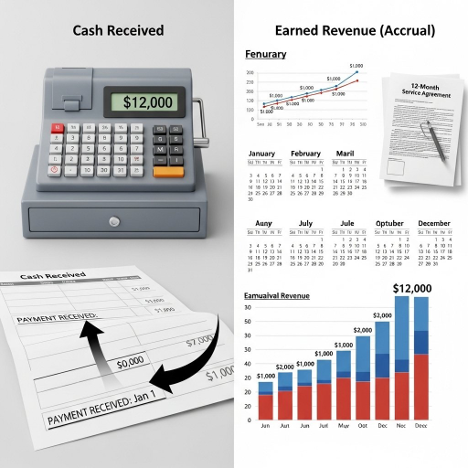
1. Cash ≠ Revenue
Receiving $600 up-front for an annual plan does not mean you earned $600 this month; you earned $50 and banked $550 in deferred revenue. Talk accrual, not deposits.
2. GMV ≠ Revenue
If you clipped a 2 % fee on $100 k of marketplace volume, your revenue is $2 k, not $100 k. Groupon tried the other story; the SEC had thoughts.

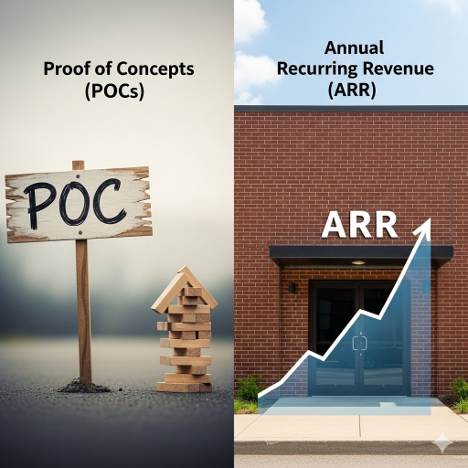
3. POCs ≠ ARR
A proof-of-concept is a paid audition. Until the customer signs a multi-year deal, it’s project revenue, not recurring revenue.
4. Services ≠ ARR
Implementation, training, custom reports—great margin boosters, terrible ARR fodder. Keep them on their own line, or watch your SaaS multiple evaporate.

5. Transaction Fees ≠ ARR
Per-drink fees are variable, rising and falling with usage. Bundle them with SaaS, and you’ll confuse everyone, including yourself.

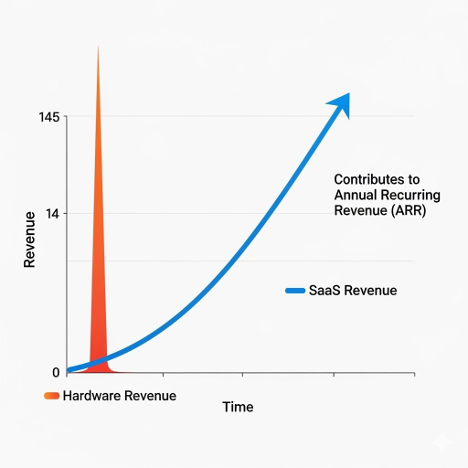
6. Hardware ≠ ARR
That IoT widget you ship once? One-shot revenue with funky margins. Treat it like ARR and you’ll look bigger today… and smaller tomorrow.
7. So… what actually is ARR?
The annualised value of all active subscription contracts, excluding everything one-time or variable.
Explicitly not included: set-up fees, pro-serv, usage-based charges, hardware, or ad-hoc upsells.
The ARR Waterfall — your new best friend
Show investors how ARR moves each month:
| Component | What it captures |
|---|---|
| Starting ARR | Baseline on Day 1 |
| New ARR | Net-new customers |
| Expansion | Seat/plan increases |
| Contraction | Downgrades & shrinkage |
| Churn | Cancellations |
| Ending ARR | The new baseline (formula below) |
Ending ARR = Starting + New + Expansion – Contraction – Churn
Best-practice revenue deck slide
- Break revenue by type: SaaS, Services, POC, Hardware, Transactions, Other.
- Show gross margin per line — one glance tells us where the engine really purrs.
- Waterfall on a second slide — month-over-month for the last 12 months.
Bringing it home
Misclassifying revenue is rarely malicious; it’s usually a result of optimism combined with sloppy bookkeeping. Unfortunately, investors can’t (and won’t) fund sloppy. Clean up the narrative, separate one-time expenses from recurring ones, and let your real momentum shine.
Get this right, and the conversation shifts from “Can I trust these numbers?” to “How big can this get?”
